


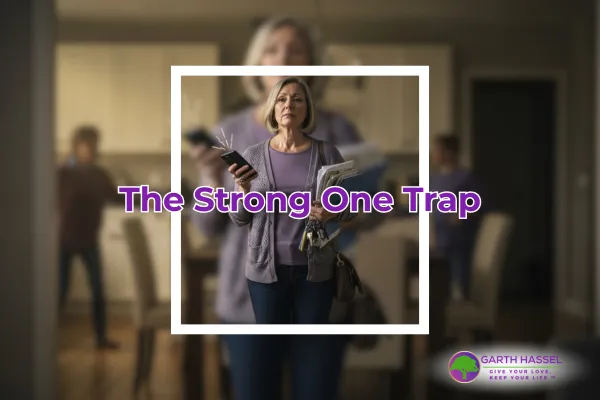
The Strong One Trap
Why Being Capable Can Cost You the Most
Every family has one.
The responsible one.
The strong one.
The one everyone calls when something goes wrong.
But strength without boundaries slowly turns into exhaustion, resentment, and silence.
In Keep Your Life™, I remind caregivers that being capable doesn’t mean being available for everything.
Exercising your power while you have it is how you protect your health, your relationships, and your future.
Can you look your kids in the eyes and promise, no matter what happens to me, you’ll be able to give me your love and Keep Your Life?
That question isn’t meant to burden you.
It’s meant to bring you back into the picture.
Can you look your kids in the eyes and promise, “No matter what happens to me, you’ll be able to give me your love and keep your life”?
If that feels hard to answer, it doesn’t mean you’ve failed.
It means you’ve been strong for a long time—maybe too long—without enough support.
You don’t have to stop loving your family to protect yourself.
And you don’t have to carry everything alone to be faithful, capable, or good.
Sometimes the most responsible thing the “strong one” can do is pause…
and decide what strength looks like going forward.
I help caregivers and families rethink roles, boundaries, and plans in a way that honors love and limits—without guilt, pressure, or overwhelm.
Schedule a short, no-pressure phone call, and let’s talk about what Give Your Love, Keep Your Life could look like for you — in your real family, with your real responsibilities, and your real capacity.
Because love is powerful.
But strength needs support.

HOMESCHOOLING: Haven or Havoc?
Your child's school years are precious and fleeting.

Now could be your best time to step up where your school is letting your child down. Let this series of myth-busting short chapters encourage you.

2 Major Mistakes
Which one will you make?

Which of these 2 retirement mistakes are you making right now? It's impossible to entirely avoid both mistakes.
You won't know for sure which mistake will work out better for you until it's too late.
How to choose?
Finding the Will
(Part 1)
Part 1: Have the will to arrange for a smooth transition when you’re no longer around to answer questions

Have the will to arrange for a smooth transition when you’re no longer around to answer questions (Part 1)
Ensuring your children or other Loved Ones can readily access your important papers when you die entails a sound process versus one or two conversations. You must overcome aversion to the subject of death, procrastination of anything that is long-term, and the tendency to assume things will be fine. Family dynamics can be sweet, spicy, or dicey.
Finding the Will
(Part 2)
Part 2: Getting Organized
While the internet permits convenient access to accounts, policies, and stored documents, it presents a plethora of password management problems. which too many people avoid by succumbing to password laziness, such as:
- re-using passwords for multiple logins, or
- use simple, easy to remember passwords, or
- writing them on sticky notes placed on their monitor or under their keyboard, or
- keeping them in a spreadsheet on their computer, or
- letting their browser remember passwords for them
Embrace Your Clarence
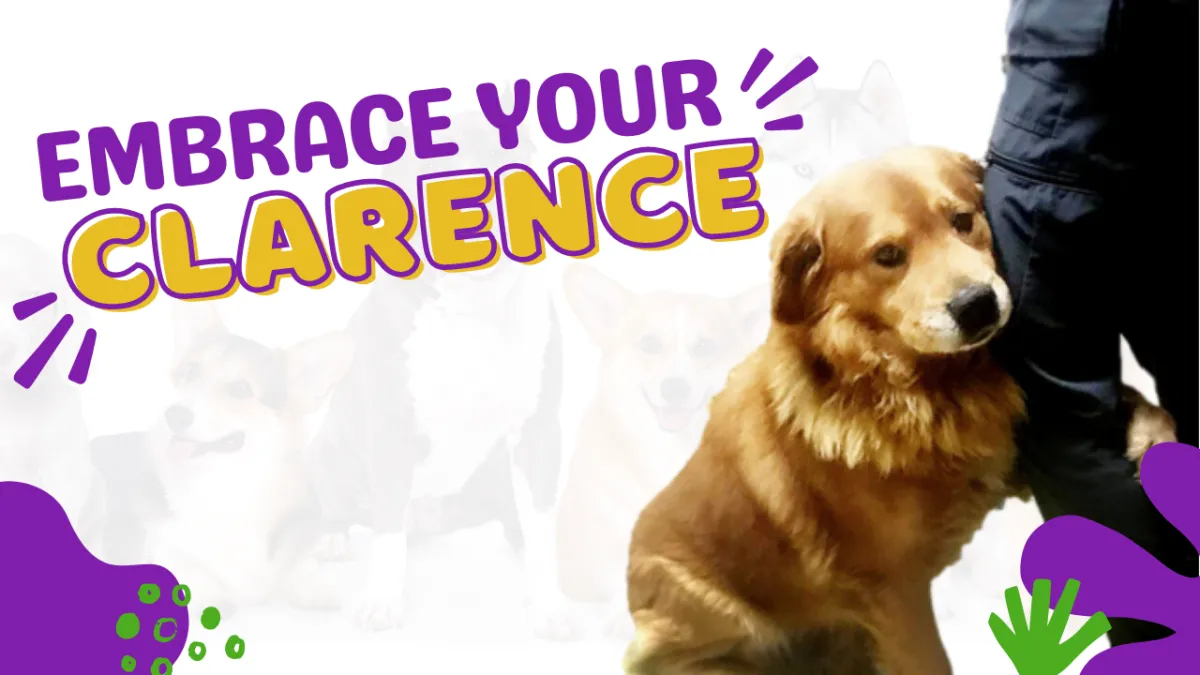
Is Clarence your future?
Golden insight from a golden retriever.
Post-Pandemic W.E.L.L.ness
Working, Earning, Learning, and Launching to Thrive

Where life drastically changed forever two years ago, everyone adjusted to the best of their abilities.
Here are a few of the key adjustments--"pandemic pivots"--that sustained some and prospered others.
Prenuptial Adulting
Equip Them for Happily Ever After

“Mom, Dad, we’re getting married!"
“Wonderful, congratulations! Here’s what you both need to do first.”
Equipping newlyweds with essentials of responsibility leaves plenty of life yet to be discovered on their own. Adults understand that love isn’t oogly feelings; it’s a hard choice. It’s putting your commitments and your money where your mouth is.
Many of the following steps also apply to one’s turning 18 years old. Becoming engaged adds urgency and a deadline.
Rethinking Competing Funds for College and Retirement

We live in a time of skyrocketing inflation topping decades of unbridled higher education costs.
Is the tension between funding your retirement and funding (at least partially) your children’s college education keeping you up at night?
You’re not alone.
Married? Is Your Endgame 100% or Just 50%?
Are you single? That other 50% could be whoever is most important to you.

Multiple unforgiving players factor into your retirement and estate plans (collectively your “endgame”). Household names include the Internal Revenue Service, the Social Security Administration, and the Center for Medicare and Medicaid Services. Key decisions with these players are nearly impossible to reverse. Plus, if you qualify for a pension, how you activate it is another irreversible decision.
Are you more of a planner than your spouse? It’s all too common for one spouse to blindly trust the planning spouse. Countless endgame “plans” were created by 50% of a couple: